The is seminar was a collaborative four-day international event featuring talks, workshops, and working sessions, in partnership with the School of Digital Arts at Manchester Metropolitan University, exploring emerging themes in creative industries and decentralized governance.
Henry Cooke from BBC Research and Development presented his report on future projections, addressing themes like the AI boom, a divided world and new types of interactions that we can foresee for the future. I found this research extremely insightful, especially as it touches on several central points of my research.
I agreed with his account of the current state of evidence-based policymaking, highlighting a concerning over-reliance on biased data that fails to capture the full spectrum of human experiences. There were also interesting insights into the potential of AI systems as companions that can redefine the interactions we typically have with technology and help us better understand the complex world around us. For example, the integration of AI into augmented reality glasses was cited as an illustration of how technology can augment human experiences, offering intelligent annotations and generative interpretations of the environment. This reframing of technology as an extension of our senses suggests a future where digital interfaces seamlessly integrate with our daily lives, ultimately transcending the limitations of traditional devices like smartphones.
The report's reflection on disinformation and how people see the world differently because of the information they consume was spot on. The report explains how we're living in separate realities fed by social media, especially when it comes to politics. This makes it hard to have constructive dialogues because people are not even starting from the same basic facts. It also explains how the upcoming American election might get even trickier because of new technology like ChatGPT and generative AI. This means someone could make a fake video to target specific groups of people, which could make the "trust crisis" worse. The question is, how can we redesign online spaces where people from different backgrounds can talk to each other and learn from one another? Right now, social media algorithms push us further apart. We need to find ways to bring people together instead.
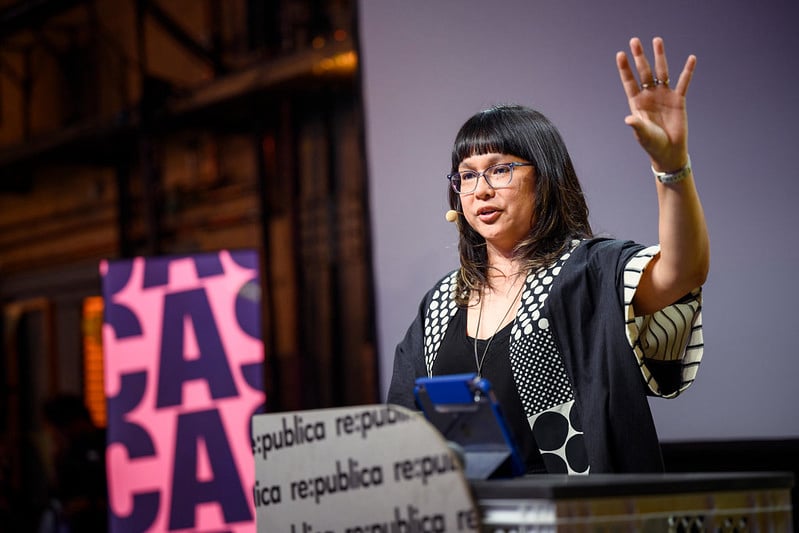
Ax Mina, expert on the future of work, technology and society, provided a thought-provoking exploration of the intersection between our visions of the future, technology, and the imaginary of magic. Building upon Arthur C. Clarke's notion that "any sufficiently advanced technology is indistinguishable from magic," Ax Mina explained how this perception shapes our expectations and interactions with technology. Her talk shed light the psychological and cultural dimensions of technological advancement, highlighting the human fascination with the supernatural and the unknown. She also touched upon the role that designers have in considering the emotional aspects of technology, beyond its functional utility, in order to create more engaging and meaningful experiences for users.
Appearing for the first time in 2008, blockchain technology revolutionised the concept of decentralized systems by creating transparent and immutable ledgers. From cryptocurrencies to NFTs and smart contracts, blockchain enables trust and transparency without relying on central authorities.
A ledger is like a digital accounting book where transactions are recorded. It's a way to keep track of who owns what, especially in financial systems. In blockchain technology, a ledger is shared across a network of computers, and each transaction is added to a chain of blocks in a secure and transparent way. This ensures that everyone in the network can see and verify the transactions, making the ledger trustworthy and tamper-proof.
Non-fungible tokens (NFTs) and smart contracts introduce new possibilities in digital ownership and automated agreements. NFT marketplaces like OpenSea provide platforms for unique digital assets, while smart contracts enable self-executing agreements without intermediaries.
Distributed autonomous organizations (DAOs) embody principles of commons governance, as outlined by Elinor Ostrom. These organizations leverage blockchain and smart contracts to facilitate participatory decision-making, conflict resolution, and economic democracy.
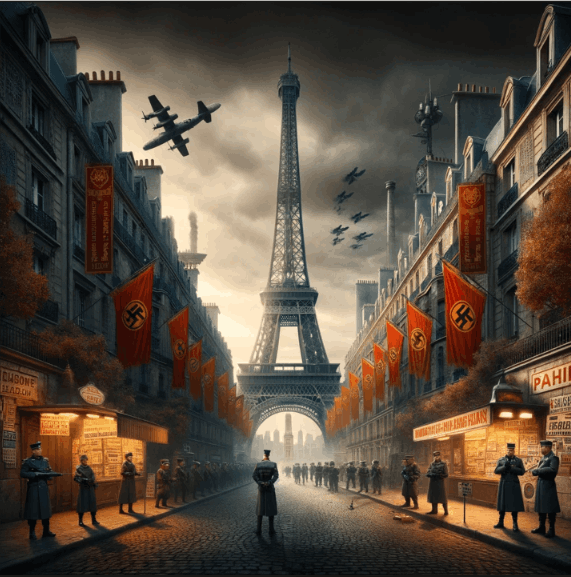
Our concept involves an educational online game designed to simulate life under an authoritarian regime to raise awareness of its dangers. The game would be accessible for download directly from the DAFNE+ platform repository. Within the game, players take the role of a journalist navigating this oppressive reality, tasked with engaging with the world and its inhabitants. Dialogues with characters are documented in a notebook, alongside the player's observations and reflections on these interactions.
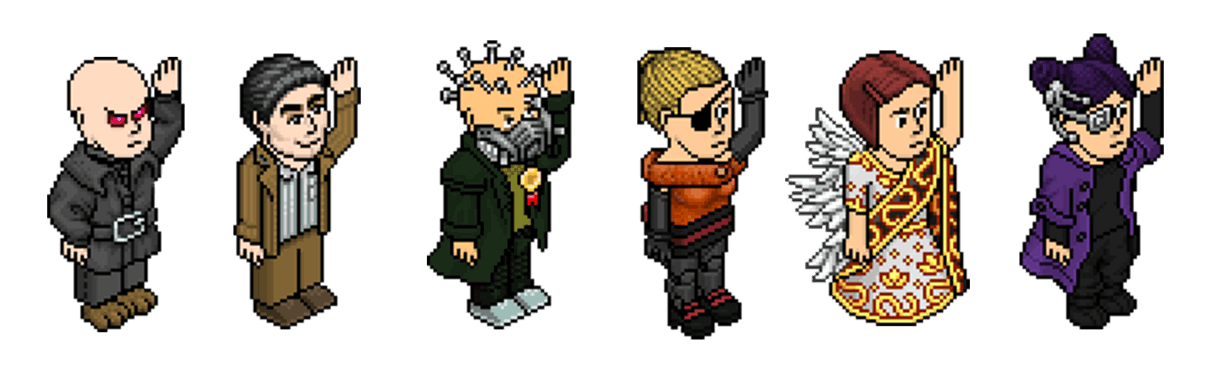
Upon completing the game, the notebook page containing the player's reflections serves as the tangible outcome of the experience. Additionally, players are encouraged to design an avatar resembling the fascist leader best characterizing the simulated world they explored. These avatars are then transformed into non-fungible tokens (NFTs) and made available on the DAFNE+ platform. Each NFT represents a unique 3D object reflecting the player's personal perspective on experimenting a fascist reality, aimed at fostering dialogue between different players. Funds collected from the NFT sales would be managed by the DAO and directed towards initiatives focused on de-radicalization.
Although I found the activity a bit too speculative and unrealistic for my taste, it was interesting to get an introduction on the functioning of decentralised governance models, NFTs and blockchain. I wish we could have gotten a more technical overview of this technology to be able to integrate it in our design practice.
Website Software